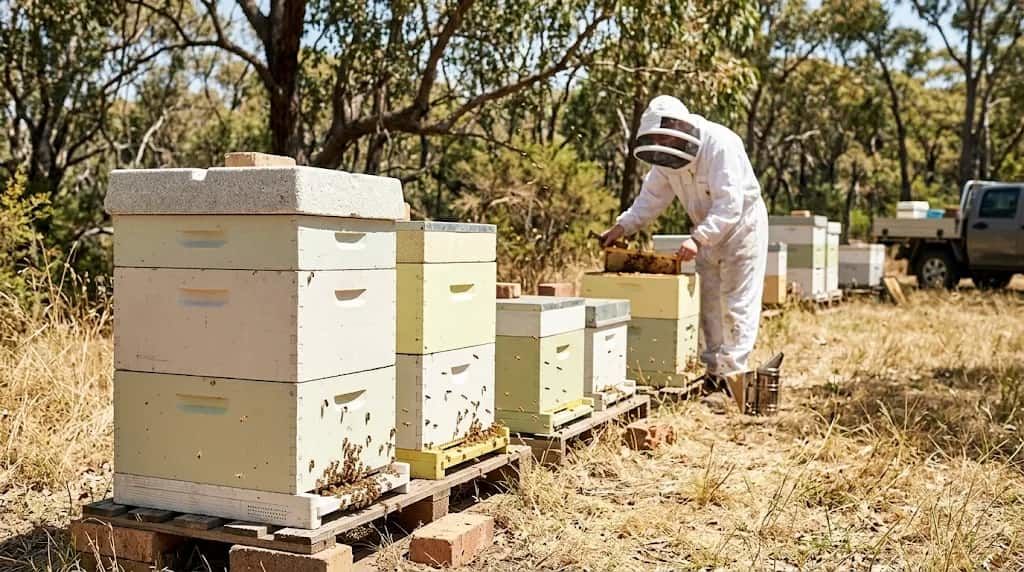
Yes, EPS hives can help honey bee colonies manage Australian summer conditions by providing greater insulation against external temperature changes. An insulated hive cannot eliminate heat stress or replace good summer hive management, but it can help create a more stable internal environment. HiveIQ EPS Hives are designed around this principle, giving Australian beekeepers an insulated alternative to traditional timber hives.
Key Takeaways
-
EPS insulation helps reduce the influence of outside temperature changes on the hive interior.
-
Bees actively regulate hive temperature through behaviours such as fanning and water collection.
-
Better insulation can reduce the amount of heat entering the hive during hot conditions.
-
Shade, ventilation, water availability and colony management remain important during Australian summers.
-
An EPS hive is one part of summer hive management, not a replacement for regular inspections.
What Happens to a Beehive During Hot Weather?
Honey bees actively regulate conditions inside their hive. When temperatures rise, worker bees use several behaviours to help cool the colony.
They may fan their wings to circulate air, collect additional water and distribute moisture through the hive to assist with evaporative cooling. Bees may also gather outside the entrance in a behaviour known as bearding when conditions inside become warm or crowded.
These processes require energy and resources, which is why the construction and location of a hive can matter during prolonged hot weather.
How Does an EPS Hive Help in Summer?
EPS stands for expanded polystyrene, a material with strong thermal insulating properties. Insulation slows heat transfer between the external environment and the inside of the hive.
During a hot Australian day, this can help reduce how quickly external heat affects internal hive conditions. The same principle works in reverse during colder periods by reducing heat loss.
This doesn't mean an EPS hive remains cool regardless of the weather. Rather, insulation helps moderate temperature changes and gives the colony a more stable environment to manage.
For more on the broader differences between hive materials, see our guide to HiveIQ EPS Hives vs Traditional Timber Hives.
Are EPS Hives Better for Extreme Australian Heat?
Insulation can be particularly useful where hives experience substantial temperature swings, but hive material is only one factor affecting summer conditions.
Beekeepers should also consider:
-
Hive position and exposure to afternoon sun
-
Access to a reliable water source
-
Appropriate ventilation
-
Colony strength
-
Available space within the hive
-
Local weather conditions
Even a highly insulated hive still requires appropriate management. Regular inspections allow you to assess how the colony is coping and respond to changing conditions.
Does Better Insulation Mean More Honey?
Not necessarily. An insulated hive should not be treated as a guarantee of greater honey production.
Honey yield is influenced by colony strength, nectar availability, weather, queen performance, hive health and many other factors. Insulation primarily helps provide a more stable hive environment.
For backyard beekeepers building a system around an insulated hive, the Hive to Harvest Package combines a HiveIQ hive with compatible frames and a Micro Honey Harvester for small-scale honey harvesting.
What Else Should Beekeepers Do During Summer?
Australian summer hive management should consider the whole colony rather than relying on hive construction alone.
Make sure bees have reliable access to water and monitor the hive during prolonged periods of high temperatures. Appropriate positioning can also help reduce unnecessary exposure to intense afternoon heat.
New beekeepers who want practical help understanding seasonal hive management can explore our Beekeeper Mentoring.
Choosing an Insulated Hive for Australian Conditions
EPS hives can help buffer colonies against changing external temperatures, making insulation particularly relevant during Australia's hot summers. They still need to be combined with sensible positioning, adequate water and regular hive management.
Explore our HiveIQ EPS Hives or browse the shop for equipment to build your beekeeping setup.